
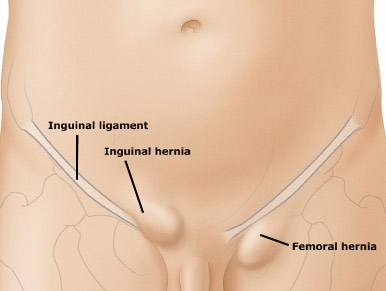
When someone has a bulge in the groin, one of the first questions is whether it is an inguinal hernia or a femoral hernia. Both occur in the same general area. Both can cause a lump, discomfort, or pain. And both can be repaired using similar overall surgical approaches.
But they are not exactly the same, and the difference matters.
The Main Difference: Above or Below the Inguinal Ligament
The simplest way to explain the difference is by where the hernia comes through in relation to the inguinal ligament.
- An inguinal hernia comes through a weak spot above the inguinal ligament.
- A femoral hernia comes through a weak spot below the inguinal ligament, through the femoral canal.
That may sound like a small distinction, but it is an important one anatomically.
Inguinal Hernias Are More Common
Inguinal hernias are much more common than femoral hernias.
That is true in both men and women.
Femoral hernias are less common overall, but they are seen more often in women than in men. So while a woman with a groin hernia may still have an inguinal hernia, we have to give careful thought to the possibility of a femoral hernia.
Why Does the Difference Matter?
It matters because the repair is slightly different.
Before surgery, it is important to identify whether a femoral hernia is present. If the surgeon assumes the groin bulge is only an inguinal hernia and misses a femoral hernia, the repair may not fully address the problem.
In other words, the surgeon needs to know exactly where the hernia is coming through in order to repair it correctly.
Do They Feel Different?
Sometimes, but not always.
Both inguinal and femoral hernias can cause:
- a bulge in the groin
- pressure or discomfort
- pain with standing, lifting, or straining
- a lump that may come and go
Sometimes the location of the bulge gives a clue. But in real life, the difference is not always obvious to the patient. That is one reason a good physical exam is important.
How Are They Repaired?
Although the anatomy is slightly different, the general approach to repairing them is similar.
Both inguinal and femoral hernias can be repaired using:
- an open approach
- a laparoscopic approach
- a robotic approach
The best choice depends on the exact anatomy, the type of hernia, and the surgeon’s judgment and experience. Typically mesh is used regardless of the approach but a non-mesh option might be considered using the “open technique”.
The Bottom Line
An inguinal hernia and a femoral hernia are both groin hernias, but they come through different weak spots.
The main difference is this:
- inguinal hernia = above the inguinal ligament
- femoral hernia = below the inguinal ligament
Inguinal hernias are more common overall in both men and women. Femoral hernias are less common, but they are seen more often in women than in men.
It is important to identify whether a femoral hernia is present before surgery, because the repair is slightly different. Still, the general surgical options are similar, and both can usually be repaired using open, laparoscopic, or robotic techniques.
This article is for general education only and is not personal medical advice. The best treatment plan depends on the examination, the exact anatomy, and the individual patient.